About us
Our goals

ReaDi is multilingual, inclusive, and digital, and

promotes language acquisition and development in children through dialogic reading across family contexts, early childhood education, kindergarten, and school,
focuses particularly on the needs of children who are deaf or hard of hearing and those with a migration background,
provides 16 digital picturebooks in German Sign Language, German, Arabic, English, and Turkish with integrated tips for dialogic reading, and
enhances the practical skills of parents and educational professionals in shared book reading to children, also those who are deaf or hard of hearing, through differentiated multilingual tutorials.
Our team
ReaDi: Reading Digital – Inclusive Language Education with Multilingual Digital Picturebooks in Spoken and Sign Languages – is a joint project of the Humboldt University of Berlin and the Ludwig Maximilian University of Munich. It has received funding for 2022–2026 from the Federal Ministry of Education, Family, Seniors, Women and Youth (BMBFSFJ) under funding code 01JM2205A/B.
Our thanks go to
all parents and early childhood education professionals from kindergartens and schools who supported us in assessing needs and testing the website, tutorials, and digital picturebooks;
the Skarabee agency for creating the DGS videos for the picturebooks and the actors Carsten Blatz, Jan Eichler, Lars Grombelka, Roman Poryadin, Susan Pufhan, and Peggy Steinbach;
the translators Çağla Vera Arslan (Turkish), Melody Shaw (English), Haroun Ahmed Soliman (Arabic);
the speakers Christian Michalak, Cornelia Waibel (German), Tayfun Bademsoy (Turkish), Marianne Graffam (English), and Hassan Ahantat (Arabic);
the Pudelskern agency for its design and implementation of the ReaDi website;
illustrator Sonja Hansen for creating the graphics;
all publishers who enabled us to acquire the picture book licenses; and
the BMBFSFJ for its financial support.
Project team
Project leader

Humboldt University of Berlin, Department of Sign Language Education and Audio Education

Prof. Dr. Laura Avemarie
Ludwig Maximilian University of Munich, Chair of Special Education – Hearing and Communication with a Focus on Inclusive Education

Christian Müller
Ludwig Maximilian University of Munich, Faculty of Linguistics and Literary Studies, Chair of Didactics of German Language and Literature and German as a Second Language
Research Associates

Mabu Aghaei
Educator/linguist (M.A.), Humboldt University of Berlin

Nora Eisinger
Psychologist (M.Sc.), Ludwig Maximilian University of Munich
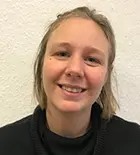
Swantje Marks
Special educator (M.Ed.), Humboldt University of Berlin
Student Assistant

Madleen Richter
Student of special education with a focus on hearing and communication, Humboldt University of Berlin

Emma Dopfer
Student of special education with a focus on hearing and communication, Ludwig Maximilian University of Munich

Marlene Heck
Student of special education with a focus on hearing and communication, Ludwig Maximilian University of Munich
Anne Stutzer and Sarah Imhof (research associates) as well as Mileva Dönnges, Florian Ritter, Lucia Roth, Lillian Siebert, and Jana Steck also contributed to parts of the project.
Practice Partner






Fachseminar Förderschwerpunkt
Hören und Kommunikation, Berlin
Senatsverwaltung für Bildung, Jugend und Familie
(Klaus Jürgen Heuel)
Fachseminar Förderschwerpunkt
Hören und Kommunikation, Berlin
Senatsverwaltung für Bildung, Jugend und Familie
(Klaus Jürgen Heuel)






Our concept
Our target groups
Our Guidelines for Education and Teaching
1. Inclusive
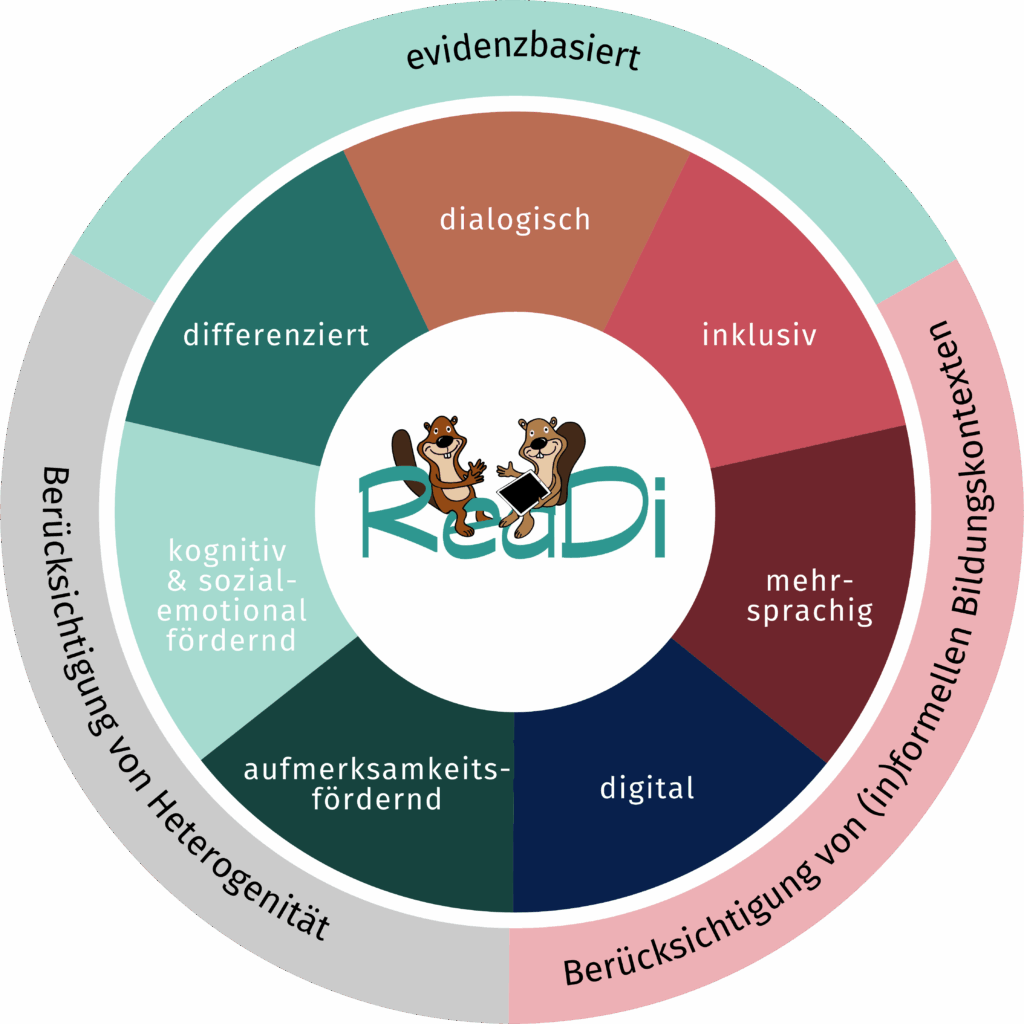
Our digital picturebooks are designed to address the diverse needs and learning requirements of children.
In our tutorials, we show how shared book reading can effectively support children in diverse language groups, representing a special contribution to inclusive learning.
2. Multilingual
The website is available in five languages: German, German Sign Language, Arabic, English, and Turkish.
Our tutorials provide practical guidance on how multilingual families and educational professionals can actively support children’s linguistic diversity in both spoken and sign languages.
There is a particular focus on incorporating German sign language during shared book reading.
3. Digital
Our digital picturebooks offer low-barrier access to shared book reading and reading.
They are freely available, include sign language videos, and can be flexibly adapted to meet the individual needs of children.
The tutorials demonstrate how our digital picturebooks can be effectively used for shared book reading.
4. Attention-promoting
Our tutorials teach strategies to support attention and concentration during shared book-reading sessions, promoting positive reading experiences.
5. Cognitive and social-emotional development
The ReaDi picturebooks and accompanying tips encourage the strengthening of important areas of development during shared book reading:
- understanding the thoughts and feelings of others (theory of mind),
- emotional knowledge, and
- children’s world knowledge.
Our tutorials show how these skills can be specifically promoted.
6. Differentiated
In the tutorials, parents and professionals learn how to assess children’s linguistic and cognitive skills and adjust shared book reading activities accordingly.
Our diverse collection ranges from hidden-object and narrative picturebooks to non-fiction picturebooks, with varying levels of difficulty and suitable for different developmental stages.
7. Dialogical
Dialogic reading is the core of our work.
The picturebooks contain prompts for discussions with the children on every page.
In addition, the tutorials offer further suggestions on how dialogic reading can support language development and follow-up communication.
Our research
Our approach
Our approach is
interdisciplinary:
ReaDi was developed by an interdisciplinary team of colleagues who were deaf, hard of hearing, or hearing.
participative:
The project engaged parents who were deaf, hard of hearing, or hearing, educational professionals, and school administration representatives in two scientific advisory boards during the development of ReaDi.
evidence-based:
ReaDi was developed in four steps:
1.
Survey of reading practices and needs in shared book reading activities among parents who were deaf, hard of hearing or hearing and educational professionals.
2.
Development of digital picturebooks in multiple languages, including prompts and questions for dialogic reading.
3.
Development of multilingual digital training programs for families and educational professionals.
4.
Evaluation of digital picturebooks and training programs by parents who were deaf, hard-of-hearing, or hearing and educational professionals.
Our publications
Eisinger, N., Aghaei, M., Becker, C., Marks, S., Stutzer, A., Müller, C., & Avemarie, L. (2024).
Vorlesepraktiken von Eltern tauber und schwerhöriger Kinder. Frühförderung Interdisziplinär, 43(3), 135–154.